
Pickleball Injury Treatment in Huntington & Syosset, NY
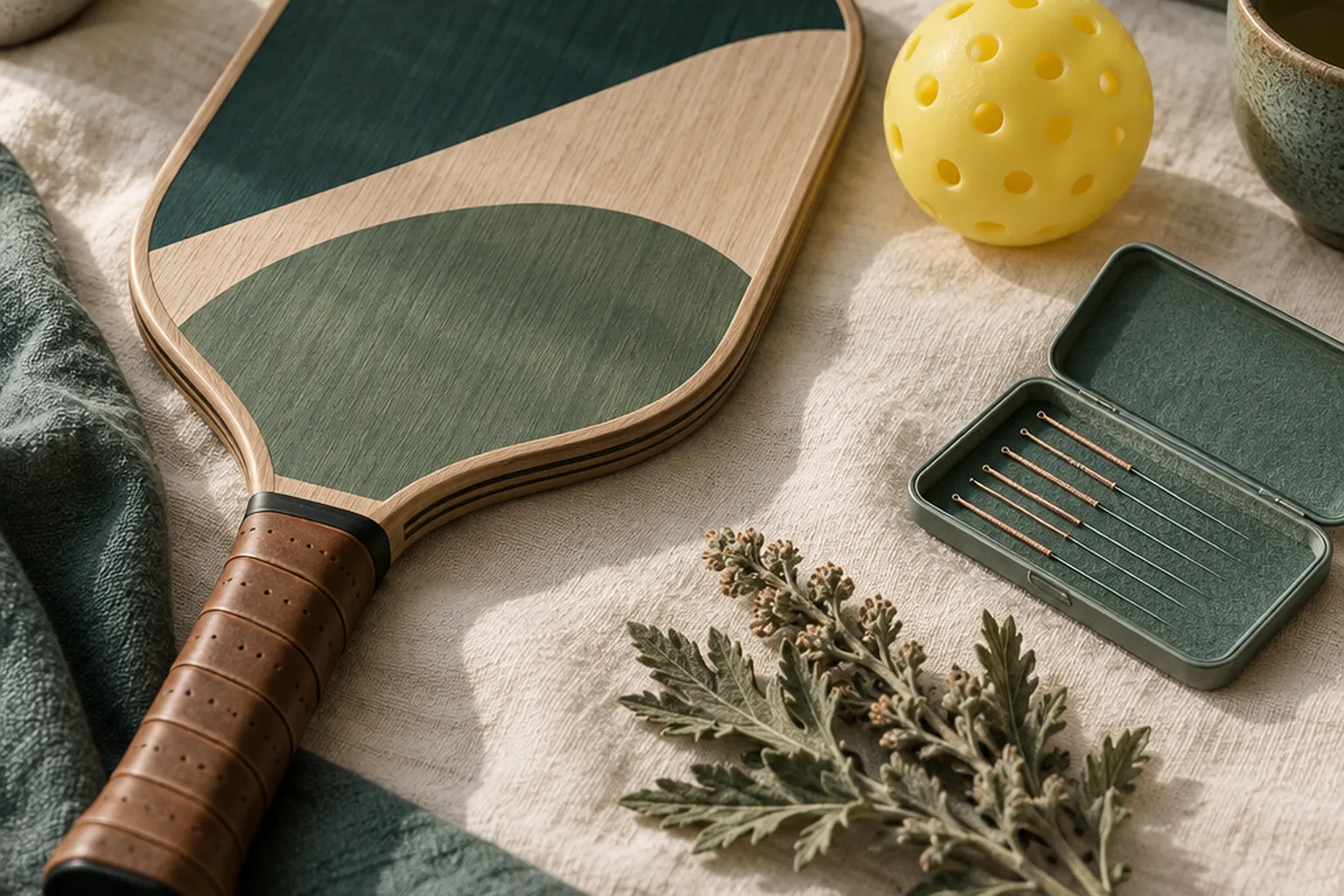
As pickleball moves indoors for the colder months, we start seeing the same pattern at our Huntington office: players who have been hurting for weeks, already tried rest, ice and a brace, and want to know how to get back on the court. Most of them aren't looking to quit. They play three or four times a week and want a plan that respects that. Here's what we see most, how to tell a strain you can play through from one you can't, and why the spot that hurts often isn't the spot that needs treatment.
What are the most common pickleball injuries?
Most of the pickleball injuries we treat are in the arm and upper body:
- Tennis elbow (lateral elbow pain). Pain on the outside of the elbow from the forearm muscles that extend the wrist. Backhands, a tight grip and long dinking rallies all load these tendons over and over.
- Golfer's elbow (medial elbow pain). Pain on the inside of the elbow, where the muscles that flex the wrist and grip attach. Forehands with a lot of wrist and a death grip on the paddle are common culprits.
- Wrist and forearm pain. Pickleball asks the wrist to stabilize a paddle through thousands of quick, short contacts. The tendons on both sides of the wrist can get irritated, especially in players who flick the ball with their wrist instead of moving from the shoulder.
- Shoulder pain. Overhead serves, put-aways and reaching for wide balls load the rotator cuff, and most recreational players never train those muscles for the volume they play.
- Neck tension. Often the hidden partner of everything above. Hours in the ready position, eyes up, shoulders tense, can feed pain all the way down the arm.
Less often, we see lower-body injuries: calf and Achilles strains from the quick push-off, and hip, SI joint and low back pain from pivoting fast or twisting suddenly. We treat those too; they just walk in less often than arm and shoulder problems.
Why I might barely touch the spot that hurts
This surprises a lot of pickleball players: the area that hurts is often not the area I spend the most time on. Sometimes it gets the fewest needles of anything I treat. That's because the painful spot is usually where the strain shows up, not where it starts. Wrist pain can come from the neck and shoulder. Elbow pain can come from the hand and wrist, or from a muscle up the arm that isn't firing the way it should. If I only treated the elbow, you'd feel better for a few days, and then the same problem would bring the pain right back. The exam tells me where the problem actually lives, and that's where most of the treatment goes.
It also explains why a brace often doesn't fix it. A brace supports the spot that hurts. If that spot isn't the source, the strain just keeps coming from somewhere else.
Can I keep playing, or do I need to stop?
Most players don't need to stop completely, but how the pain behaves matters.
Usually OK to keep playing, with less volume: soreness that's stiff at the start of a session and eases as you warm up, mild ache after playing that's gone by the next day, and pain that doesn't change how you swing or move.
Take it out of the rotation and get it checked: pain that sharpens with every push-off or every contact, swelling, a joint that gives way, pain that changes your stroke or your footwork, and pain that's there while you play and gets worse afterward, especially at night. That last pattern usually means the tissue is worn down and isn't recovering between sessions, and playing through it tends to make it last longer.
That timing tells me something about treatment too. Pain that's worst at the start of a game and loosens as you play usually points to tissue that's tight and overloaded, what acupuncture calls excess. Pain that's fine early but builds by the third game, and is worse that night, points to tissue that's worn down and can't keep up, or deficiency. The two get treated differently.
Why does pickleball elbow happen even to players with good form?
Good form helps, but it doesn't cancel out load. Pickleball elbow is mostly a volume problem: lots of games, lots of short, sharp contacts, often on consecutive days, with tissue that never gets time to recover. A grip that's too small makes you squeeze harder. A heavier paddle adds strain to every shot. And the soft game itself, all that dinking at the kitchen line, keeps the wrist cocked and the forearm muscles engaged for long stretches. None of that means your technique is bad. It means the tendons are doing more work than they've been conditioned for.
What you've probably already tried, and why it didn't stick
By the time pickleball players come in, most have tried rest, ice, heat, a brace and ibuprofen. Some have been to physical therapy or a pain management doctor, and some have had a cortisone shot. These can all help, but there are a few reasons they often don't finish the job.
Icing for weeks. Ice can help with pain right after an injury. Leaning on it day after day is a different story. Cold constricts blood vessels, and a slow-healing tendon needs blood flow to repair itself and clear out damaged tissue. The evidence that icing actually speeds soft-tissue healing has always been thin — a review in the Emergency Medicine Journal found the clinical trials too limited to support it even for acute injuries. Sports-medicine guidance has since moved away from prolonged icing toward protecting and gradually loading the tissue, and even the physician who popularized the "RICE" formula has publicly revised his own advice about ice. The British Journal of Sports Medicine framework that replaced it now cautions against routine icing because inflammation is part of how tissue repairs.
Why cortisone often doesn't last. Cortisone is a powerful anti-inflammatory, and it can calm a painful elbow quickly. What it can't do is change why the elbow hurts. This is not just a clinical impression: in a randomized trial published in JAMA, patients with tennis elbow who received a corticosteroid injection did better in the short term but had worse recovery and more recurrences at one year than those given a placebo injection, a pattern that also shows up across tendinopathy injection trials. Often the pain comes from a muscle that isn't firing properly, so other muscles get recruited to do a job they weren't built for. For example, if the triceps isn't engaging well as you straighten your arm, the biceps and its tendon can end up taking on extra work, and the overloaded tissue starts to hurt. The shot quiets that pain for a while, but until the muscle that isn't doing its job is addressed, the strain keeps building.
Does acupuncture help pickleball injuries?
Acupuncture works on the parts of the problem the other approaches miss. Needling reduces the muscular guarding around an irritated joint, increases local circulation to where the tendon meets the muscle, and helps restore range of motion you've lost. The best evidence for acupuncture in pain comes from an analysis of individual patient data from 39 trials and more than 20,000 patients with chronic musculoskeletal pain, published in The Journal of Pain, which found the effects persist well beyond the course of treatment.
For tennis elbow specifically, the research is more limited. A systematic review and meta-analysis in Acupuncture in Medicine found that manual acupuncture and electroacupuncture reduced pain and improved function in lateral elbow pain, with the caveat that most of the trials were small and of modest quality, and a separate review reached a similar conclusion. That's honest evidence, not proof, and it's worth saying so.
I use points both near the problem and farther away. Local points release the overworked tissue. Points up the arm, in the shoulder and neck, or in the hand address where the strain is coming from. Others help calm the nervous system's response to pain. None of this is a guarantee, but it's built around fixing the cause, not just quieting the symptom.
Where the needles might go
There's no standard pickleball point recipe. The points I choose depend on what the exam shows, and I won't use the same ones for every player or every visit. But a few examples show how points line up with the anatomy behind common pickleball injuries:
- LI11, at the outer end of the elbow crease, sits over the brachioradialis and extensor carpi radialis longus, near the common extensor tendon at the outer elbow. These are the muscles that extend and stabilize the wrist, and the area involved in tennis elbow.
- HT3, at the inner end of the elbow crease, sits over the pronator teres, near the common flexor tendon at the inner elbow. That's where the gripping and wrist-flexing muscles attach, and the area involved in golfer's elbow.
- LU3 and LU4, on the front of the upper arm along the outer edge of the biceps brachii, over the brachialis. These help when the biceps is overworking to cover for a muscle that isn't doing its job.
- LU10, on the thenar eminence, the fleshy pad at the base of the thumb, sits over the abductor pollicis brevis and opponens pollicis. These muscles control the thumb and are essential for gripping, which matters for every shot you hit with a paddle.
- SI3 through SI6, along the outer edge of the hand and wrist, run over the abductor digiti minimi at the edge of the hand and past the extensor carpi ulnaris tendon on the pinky side of the wrist. These points sit on a channel that runs from the hand up to the shoulder blade and neck, which is a good example of how hand and wrist points can help with problems higher up the arm.
These are examples, not a protocol. Some players won't get any of them.
How soon can I get back on the court?
The biggest factor is how long you played through it before coming in. Pain that's a few weeks old, where muscles are locked up or not firing properly, can turn around in two or three sessions. Tendons that have been breaking down for months need time to actually repair, and that takes longer. For a closer look at timelines, see how many acupuncture sessions you may need.
One session rarely fixes everything, and that's not the goal. Your first few treatments also tell me a lot: how your body responds confirms the diagnosis or points me toward what's really driving the pain. If the first session doesn't change much, that's information, not failure. Some soreness the same day or the next day is normal. Individual results vary.
What else helps between sessions?
A few general habits make a real difference:
- Warm up before your first game. Don't use game one as the warm-up. A few minutes of easy movement and light rallying before you play competitively goes a long way.
- Keep your calves and hips mobile. Stiffness in the lower body makes the arm and back work harder to compensate.
- Check your grip and paddle. A grip that's too small or a paddle that's too heavy for you adds strain to every shot.
- Don't play five days in a row. Tendons adapt to load, but they need recovery time to do it.
What about hip, SI joint and low back pain from pickleball?
Quick pivots, lunges for wide balls and sudden twisting movements can strain the hip, the SI joint or the low back. These often get confused with each other, and with sciatica. We cover how to tell them apart in our post on hip, SI joint and sciatica pain, and if leg pain is part of the picture, our sciatica post goes deeper.
Do you treat players from Syosset and the surrounding courts?
Yes. Our office is in Huntington, and pickleball players drive in from Syosset, Plainview, Jericho, Commack and Dix Hills, as well as Northport, East Northport and Greenlawn. Players often search for a "pickleball pain doctor" on Long Island; what many of them actually need is a licensed acupuncturist who works mainly with pain and injury, especially if the usual options haven't held.
When a pickleball injury needs imaging or a referral first
Some injuries need a physician or imaging before anything else. Get evaluated first if you felt a pop or snap at the back of your ankle followed by a weak push-off, can't put weight on the leg, have a knee that truly locks, notice numbness or weakness that's getting worse, or have pain at night that doesn't change with position or activity.
Many of our patients come to us after that workup, or while they're working with their doctors. We screen for these signs in every exam, and once the serious causes are ruled out, we often treat alongside your other providers.
Get back on the court
East to West Wellness Center is at 607 W Jericho Tpke in Huntington. Your first visit runs about 90 minutes, including a full exam, and follow-ups are about an hour. The evaluation is $100 and each treatment is $165, or $265 when the evaluation and first treatment happen the same day. We'll email intake paperwork ahead of time so we can check your insurance benefits before you come in. Call (631) 416-4940 to schedule.
Frequently asked
Does acupuncture help pickleball elbow?
It can. Acupuncture releases the overworked forearm muscles, improves circulation to the irritated tendon, and addresses problems up and down the arm that often drive elbow pain. Results vary, so treatment starts with a full exam.
Can I play while I'm being treated?
Often, yes, with less volume. If your pain eases as you warm up and is gone by the next day, cutting back is usually enough. If it sharpens with every shot, causes swelling, or gets worse after you play, especially at night, take a break and get it checked.
How many sessions will I need?
It depends mostly on how long you've played through it. Recent strains can improve in two or three sessions; tendon problems that have built up over months take longer. Your response to the first treatments helps us refine the plan.
Does it hurt?
Most people feel very little as the needles go in. You may feel a dull ache as a muscle releases, and some soreness the same day or next day is normal.
How much does treatment cost?
The evaluation is $100 and each treatment is $165, or $265 when the evaluation and first treatment happen the same day. We check your insurance benefits before your first visit.
Do you treat pickleball players from Syosset?
Yes. Our office is in Huntington, and players drive in from Syosset, Plainview, Jericho, Commack, Dix Hills, Northport, East Northport and Greenlawn.
Keep reading
Talk it through with a licensed acupuncturist
New patients start with a $100 evaluation at our Huntington clinic. Call (631) 416-4940 or book online.