
Hip Pain, SI Joint or Sciatica? Acupuncture in Huntington, NY
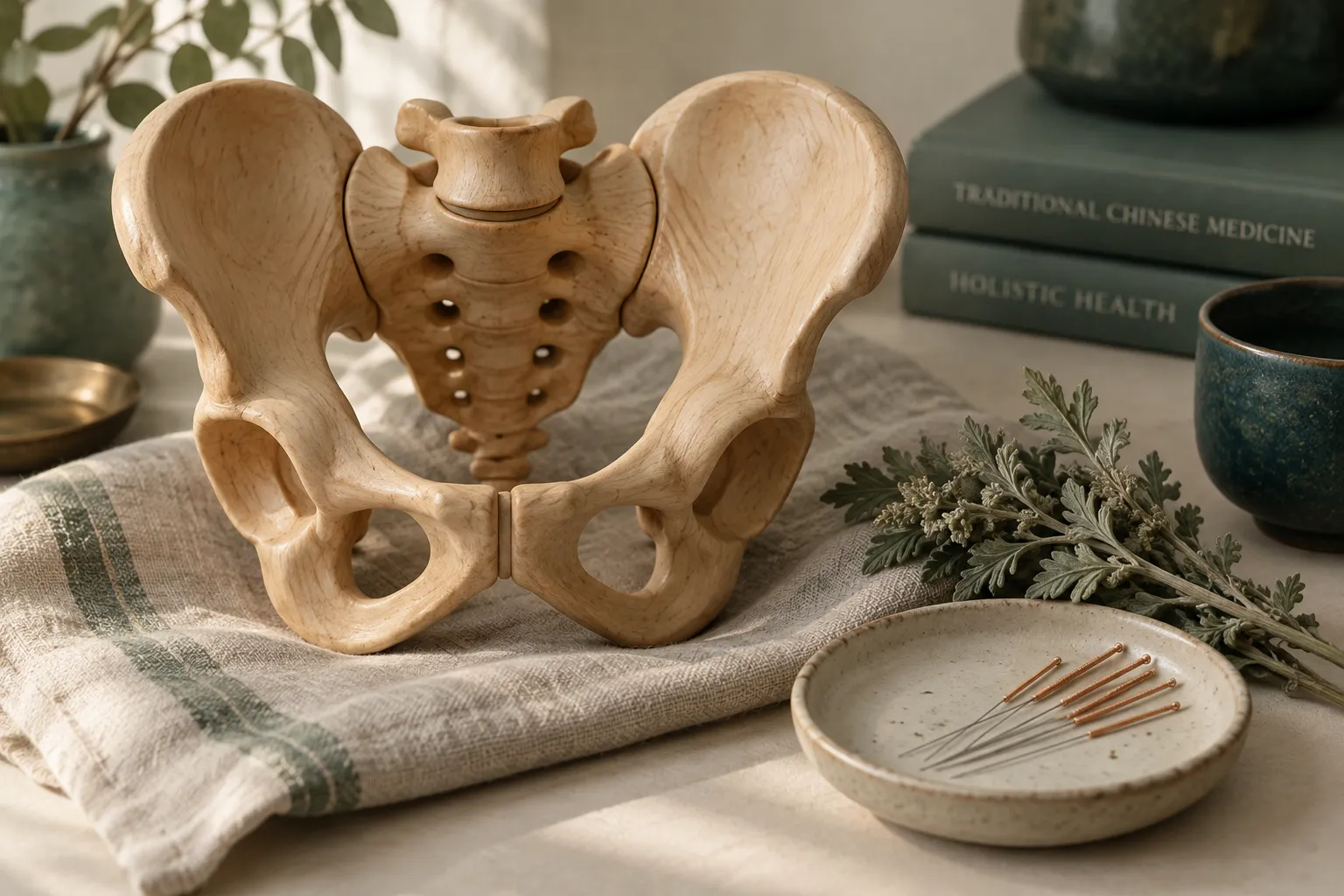
Hip pain, SI joint pain and sciatica get confused constantly, by patients and sometimes by providers. They can hurt in overlapping places and send pain down the same leg. But they're different problems, and treating the wrong one is one of the most common reasons hip pain hangs around for months. Here's how to tell them apart, why the hip is trickier than it looks, and what acupuncture can do for each.
Is it your hip, your SI joint, or your sciatic nerve?
Start by noticing where it hurts and what sets it off.
Your hip. Hip joint problems usually show up in the groin or the front of the hip and get worse with pivoting, getting in and out of a car, or putting on socks and shoes. Pain on the outside of the hip is often the tendons and tissue around the joint rather than the joint itself, and it tends to hurt when you lie on that side, climb stairs, or stand on one leg.
Your SI joint. The sacroiliac joints sit where your spine meets your pelvis, roughly under the two dimples at the back of your waistline. If you can point to the pain with one finger near that dimple, on one side, that's a strong hint. SI pain is often worse rolling over in bed, standing up after sitting, or standing on one leg. It can spread into the buttock or back of the thigh but rarely travels below the knee.
Your sciatic nerve. True sciatica comes from irritation of the nerve roots near the spine, with pain traveling down the leg, sometimes below the knee, often with numbness or tingling. The catch is that piriformis syndrome and nerve entrapment lower in the leg, even at the ankle, can feel almost exactly the same. Telling them apart takes an exam. One test I rely on is the straight leg raise, which helps show whether the irritation is coming from the spine. Another clue is whether the pain is in one leg or both: problems at the piriformis or ankle usually affect one side, while symptoms in both legs point toward the spine and should be checked by a physician promptly.
No single test settles it. When several findings point the same way, such as where the pain travels, how it responds to the straight leg raise, and whether one or both legs are involved, the picture gets clearer and I can be more confident whether it's coming from the spine or from somewhere like the piriformis.
When the signs do point to the spine, the irritation usually comes from something pressing on a nerve root: a herniated disc, narrowing of the spinal canal (spinal stenosis), narrowing of the openings where the nerves exit (foraminal stenosis), or a vertebra that has slipped out of alignment (spondylolisthesis). Those need imaging to confirm, which is when I'll refer you to a physician, often while we keep working on the muscles around the problem. We cover sciatica in depth in our post on acupuncture for sciatica.
Piriformis syndrome: same nerve, different spot. The sciatic nerve runs under, and sometimes through, the piriformis muscle deep in the buttock. When that muscle tightens or spasms, it can irritate the nerve and send pain down the back of the leg much like sciatica. The difference is where the irritation starts: the buttock instead of the spine. It's often worse with sitting, and the low back itself may feel fine.
These are clues, not a diagnosis. Plenty of people have more than one going on at once.
Why hip pain is complicated
The hip is a crossroads. Problems there don't only affect the hip, and they don't always start there. As covered above, problems in the low back can send pain into the hip. So can the way your foot strikes the ground, or a nerve irritated as far down as the ankle. Favoring one side for months changes how the other side works too. That's why I don't treat just the spot that hurts. I check how everything above and below it moves before deciding where the problem actually lives.
What causes SI joint pain?
The SI joints are built for stability, so problems usually come from too much movement or uneven loading:
- Pregnancy and postpartum. Hormones loosen the ligaments around the pelvis to prepare for birth, and the joints can stay unstable for a while afterward.
- Uneven gait, leg length or ankle problems. Small asymmetries load one side of the pelvis harder with every step. An old ankle sprain or an unstable ankle can do the same thing: the body compensates up the chain, and the hip or SI joint ends up taking the strain.
- Prolonged sitting, especially with crossed legs. Hours in a chair stiffen the surrounding muscles and change how the pelvis moves. Crossing the same leg over the other every day pulls the pelvis unevenly and can throw one SI joint off over time.
- One-sided sports. Golf, tennis, pickleball and other sports that rotate or load one side repeatedly can strain one SI joint more than the other.
What causes hip pain that isn't arthritis?
Arthritis gets blamed for a lot of hip pain, but many cases are soft-tissue problems:
- Gluteal tendinopathy. Irritated tendons on the outside of the hip, a common cause of pain lying on your side.
- Bursitis. Inflammation of the fluid-filled cushions around the hip.
- Labral irritation. Strain on the ring of cartilage around the hip socket, often felt deep in the groin, sometimes with clicking or catching.
- Hip flexor overload. Tight, overworked muscles at the front of the hip, common in people who sit a lot or run and kick a lot.
How I figure out what kind of pain you have
Two things guide my treatment: where the pain is, and how it behaves.
How it behaves comes down to timing. If your hip is stiff and sore in the morning or at the start of activity, then loosens up as you move, that points to what acupuncture calls excess: tissue that's tight, stuck and overloaded. If it feels fine when you start but builds the longer you go and lingers afterward, or it's always there and use makes it worse, that points to deficiency: tissue that's worn down and can't keep up. The difference changes where I place needles and how I treat.
I also test how your hip moves in every direction, front and back, and watch where you feel the work.
Sometimes the muscle that hurts isn't the one causing the problem
When I ask a patient to slide their heel toward their glutes, the hamstring should do most of the pulling. If they feel it mostly in the front of the thigh instead, the hamstring is underperforming and the quad is compensating. Over time, the overworked muscles tighten, guard and start to hurt, often around the hip or low back. Treatment works in both directions: calming the muscles doing too much and waking up the ones doing too little, so the work gets shared properly again.
Your age doesn't tell me what kind of pain you have
People expect older patients to have worn-down patterns and younger ones to have tight, overloaded ones. Sometimes that's true. But I regularly see teenage athletes whose muscles are run down from how they train, and people who barely move whose hips are locked up from sitting in one position all day. Your age, your activity level and the name of your diagnosis are all clues, not answers. That's why the exam comes first.
Does acupuncture help hip and SI joint pain?
Acupuncture and moxibustion increase blood flow to the tissue around the joint, which supports the body's own repair process, especially in tendons and ligaments that have been breaking down. The laboratory work behind that is still early: in animal wound-healing studies, acupuncture and moxibustion increased fibroblast activity and new blood vessel formation in healing tissue, but those are animal models, not proof of what happens inside a human joint. What's better established is the pain side. A meta-analysis of individual patient data from 39 trials and 20,827 patients found acupuncture more effective than both sham and no-acupuncture control for chronic musculoskeletal pain and osteoarthritis, with effects that largely persisted at one year. Evidence specific to the hip is thinner: a 2023 systematic review of 12 trials found acupuncture promising for hip pain but rated the quality of the underlying studies as low, with no serious adverse events reported. And clinically, what's plain in the treatment room is that releasing the muscles around a painful joint takes pressure off it and helps it move the way it should.
I work on the muscles and tissue around the hip and pelvis: the glute medius and minimus, the piriformis, and the quadratus lumborum in the low back. Releasing those reduces the guarding and tension that keep a painful area locked up. I use points both near the pain and farther away. Local points work directly on the tight or fatigued tissue. Distal points, on the legs and feet, help calm the nervous system's response to pain, so the body stops bracing around the problem.
Where the needles go, and what's underneath them
Acupuncture points aren't random. Many of the ones I use for hip pain sit right over the muscles causing trouble. I don't follow a fixed recipe, and every treatment depends on the exam, but a few points come up often:
- GB29, between the front of the pelvis and the bony point on the side of your hip, sits over the tensor fasciae latae (TFL) and the front of the glute medius. These muscles stabilize the hip and often get overworked, especially in people who sit a lot or favor one side.
- GB30, deep in the buttock, sits over the glute max with the piriformis and sciatic nerve underneath. It's one of the most-used points for hip pain, and especially relevant when piriformis tension is irritating the nerve.
- ST31, at the top of the front of the thigh, sits over the hip flexors where they cross the front of the hip. It's useful when tight hip flexors are pulling on the pelvis.
These are combined with points elsewhere on the body, chosen based on what the exam shows.
Acupuncture or a chiropractor for hip pain?
These don't compete. A chiropractic adjustment works on joint position and movement. Acupuncture works on the muscles and soft tissue that hold those joints in place. If the muscles around the pelvis are tight and guarding, they can pull a joint right back out of position after an adjustment.
That's why many of our patients see both, and why we're happy to work alongside your chiropractor. Releasing the surrounding muscles first means there's less tension pulling against the adjustment afterward.
How many sessions does hip or SI pain take?
It depends on what's going on and how long it's been there. When the problem is a muscle that's locked up or tissue that isn't moving the way it should, it can turn around in two or three sessions. When tendons, ligaments or other tissue have been breaking down over a long time, they need to actually repair, and that takes longer.
Your first few treatments also tell me a lot. How your body responds confirms the diagnosis or points me toward what's really driving the pain, and I adjust from there. If the first session doesn't change everything, that isn't a failed treatment. It's information, and it makes the next one more precise. Individual results vary, which is exactly why the exam matters.
Some soreness the same day or the next day is normal, similar to after a deep massage or a hard workout.
When hip or SI pain needs imaging or a referral first
Some symptoms need to be checked by a physician or with imaging before anything else, to rule out problems like a fracture, an infection or serious nerve compression. Get evaluated first if you have pain at night that doesn't change with position, fever with hip or back pain, pain after a fall or injury, leg weakness that's getting worse, or sciatica-type pain in both legs. Numbness in the groin or inner thighs, or any loss of bowel or bladder control, is an emergency. Go to the ER.
Many of our patients come to us after their workup, or while they're working with their doctors. We screen for these signs in every exam, and once the serious causes are ruled out, we often treat alongside your other providers.
Book hip or SI joint treatment in Huntington
East to West Wellness Center is at 607 W Jericho Tpke in Huntington. Patients drive in from Syosset, Plainview, Commack, Dix Hills and Northport for hip and SI pain treatment. Your first visit runs about 90 minutes, including a full exam, and follow-ups are about an hour. The evaluation is $100 and each treatment is $165, or $265 when the evaluation and first treatment happen the same day. We'll email intake paperwork ahead of time so we can check your insurance benefits before you come in. Call (631) 416-4940 to schedule.
Frequently asked
Does acupuncture help SI joint pain?
It can. Acupuncture works on the muscles around the pelvis and low back that tighten and guard around an irritated SI joint, which helps restore normal movement. Results vary, so we start with a full exam to make sure the SI joint is really the source.
How many sessions will I need?
It depends on the problem and how long you have had it. Muscle tightness and movement problems can improve in two or three sessions; tissue that has been breaking down for a long time takes longer to repair. Your response to the first treatments helps us refine the plan.
Does acupuncture for hip pain hurt?
Most people feel very little as the needles go in. You may feel a dull ache or pressure as a muscle releases, and some soreness the same day or next day is normal.
How much does a visit cost?
The evaluation is $100 and each treatment is $165, or $265 when the evaluation and first treatment happen the same day. We also check your insurance benefits before your first visit.
Do I need to know whether it is my hip, SI joint or sciatica before I come in?
No. Sorting that out is the first part of the exam. Patients come to our Huntington office from Syosset, Plainview, Jericho, Commack, East Northport, Dix Hills and Greenlawn without a diagnosis, and we figure it out together.
Keep reading
Talk it through with a licensed acupuncturist
New patients start with a $100 evaluation at our Huntington clinic. Call (631) 416-4940 or book online.